
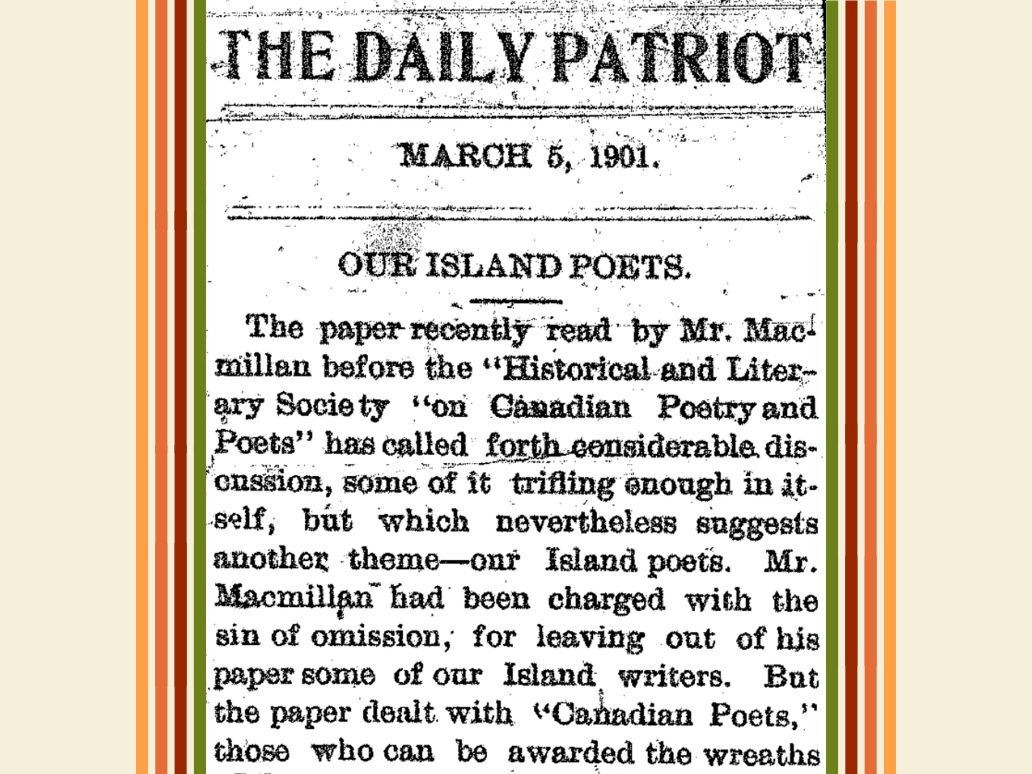
A 1901 article on Prince Edward Island poets in the Charlottetown Daily Patriot highlighted L.M. Montgomery as a “name of first repute.”
Contents
Preamble
Our Island Poets
Notes
Bibliography
Image Credit
Preamble
An unsigned article published in the 5 March 1901 issue of the Charlottetown Daily Patriot mentioned a paper that had been read at the Historical and Literary Society by someone identified as Mr. Macmillan. The focus of Macmillan’s paper on Canadian poetry and poets “suggests another theme—our Island poets.” Apparently, Macmillan’s broad focus on poets from across the Dominion of Canada meant that he had left out of the discussion “some of our Island writers.” The unidentified author of this article evidently sought to correct this omission.
The article profiles Montgomery alongside six fellow Island writers, including John Caven (1826–1914), who had taught Montgomery at Prince of Wales College. But the article devotes far more space to Montgomery and her work than it does to any of the other poets it mentions. While the publication of Anne of Green Gables seven years later certainly ramped up the amount of media attention Montgomery received, this article demonstrates that she did receive some attention and recognition for her work as a writer long before she published her first novel.
The article highlights Island poets whose work has been deemed worthy of praise, but it balances this praise with the acknowledgement of “short poems of rather negative faults,” particularly in its concluding paragraph:
The poetry that has already been produced by our Island writers is too fragmentary, and in many cases mediocre, to obtain recognition. One’s reputation cannot be sustained by one poem, for history has evidence that only two or three of the poets whose names still live base their fame on one production. While the work of the majority of our Island writer’s [sic] will not warrant them a position beside our greater Canadian poets, it is nevertheless not without some gems, which betoken poetic power of a superior type, and places its producers above the mere rhymers whose productions “are not even fit for a newspaper.”
For Montgomery, the experience of reading “this outburst” in a daily newspaper prompted “a little smile and a little heartache.” While the recognition pleased her, she was annoyed by the article’s reference to her as “Lucy Maud Montgomery” instead of as her preferred authorial signature, the more gender-neutral L.M. Montgomery. She also felt discouraged as a result of the fact that she was still mourning the death of her beloved father several months before (Montgomery, 6 March 1901, in CJLMM, 2: 9; see also Lefebvre, “Introduction: A Life in Print,” 6–7).
Our Island Poets
“Our Island Poets,” Daily Patriot (Charlottetown), 5 March 1901, 2.
Among the younger writers of to-day perhaps the name of first repute is Lucy Maud Montgomery, who is a frequent contributer [sic] to magazines of the first class. Miss Montgomery[,] although a young writer, shows marked ability and promise. She has an easy, graceful, charming style, coupled with excellent descriptive powers, which make her poems so fascinating and make them linger in one’s mind. She is impressed with the beauty of her native Province and delights to paint it in descriptive verse. The thought, too, is wholesome, for the writer has a correct understanding of life and its meaning.
Could we but know how often worn and weary
Are those we meet,
Would we condemn because they call life bitter,
Which we think sweet?
Would not our thought and judgment be more tender
To friend and foe,
Our greeting warmed with more of love’s own kindness
Could we but know?
Here is her description of “A Winter Dawn”:
Above the marge of night a star still shines,
And on the frost-rimmed hills the sombre pines
Harbor a chilly wind that crooneth low
Over the glimmering wastes of virgin snow.
Thro’ the dim arch of orient the morn
Comes in a milk-white splendor, newly born;
A sword of crimson cuts in twain the gray
Banners of shadow hosts, and lo, the day!
Miss Montgomery possesses strong descriptive powers; she has contributed frequently to our best publications and much is still expected of her.
Notes
magazines of the first class. Montgomery had published at least twelve poems in 1900 in venues such as Good Cheer (Minneapolis), the Portland (ME) Transcript, The New York Family Story Paper, The Ladies’ World (New York), The Youth’s Companion (Boston), and Good Housekeeping (Holyoke, MA).
Could we but know. The opening stanza from Montgomery’s poem “Could We but Know,” published in The Union Signal: A Journal of Social Welfare in August 1900. This poem also appears in The Poetry of Lucy Maud Montgomery (1987), selected by John Ferns and Kevin McCabe (106).
A Winter Dawn. This poem appeared in Munsey’s Magazine (New York) in December 1899. Montgomery later included it in The Watchman and Other Poems (85).
Bibliography
Lefebvre, Benjamin. “Introduction: A Life in Print.” In The L.M. Montgomery Reader, Volume 1: A Life in Print, edited by Benjamin Lefebvre, 3–28. University of Toronto Press, 2013. https://doi.org/10.3138/9781442668560-003.
Montgomery, L.M. The Complete Journals of L.M. Montgomery: The PEI Years, 1901–1911. Edited by Mary Henley Rubio and Elizabeth Hillman Waterston. Oxford University Press, 2012.
—. “Could We but Know.” The Union Signal: A Journal of Social Welfare (Evanston, IL), 9 August 1900, 467.
—. The Poetry of Lucy Maud Montgomery. Selected by John Ferns and Kevin McCabe. Fitzhenry and Whiteside, 1987.
—. The Watchman and Other Poems. McClelland, Goodchild, and Stewart, 1916.
—. “A Winter Dawn.” Munsey’s Magazine (New York), December 1899, 432.
Image Credit
Detail from the unsigned article “Our Island Poets,” published in the Daily Patriot of Charlottetown on 5 March 1901.
Leave a Reply