
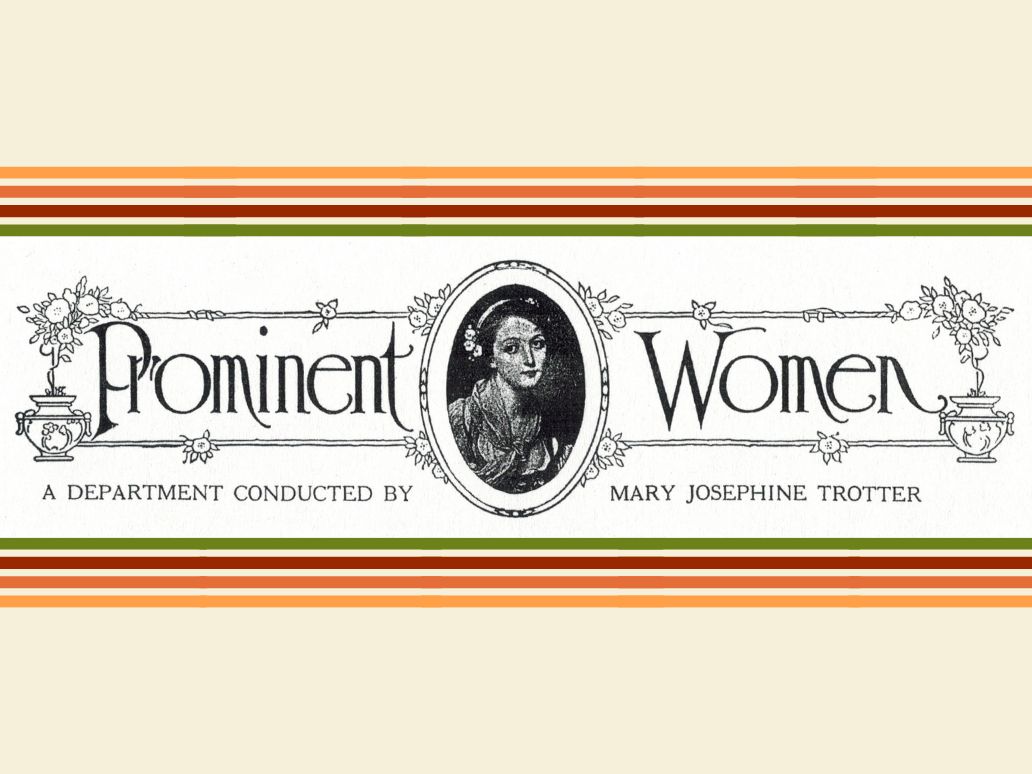
A profile of L.M. Montgomery appeared in Mary Josephine Trotter’s “Prominent Women” column in Everywoman’s World in 1914.
Contents
Preamble
The Novelist of the Isle
Abbreviations
Notes
Bibliography
Image Credit
Preamble
Throughout 1914, the first year of its publication, Toronto magazine Everywoman’s World had a regular column entitled “Prominent Women” that was conducted by Mary Josephine Trotter (1887–1965; see “Mary Josephine Benson”). This column included profiles of women who had distinguished careers not only in the arts, but also in law, academia, science, and sports. Her May 1914 column, for instance, consisted of profiles of writers Katherine Hale, Jean Graham, and Marjory MacMurchy, all of whom wrote about Montgomery or her work; her June 1914 column focused on Mrs. R.R. Jamieson, Calgary judge with the Juvenile Court, as well as Caroline M. Derick, professor of botany at McGill; and her July 1914 column profiled Mrs. Arthur Murphy (Emily Murphy), who wrote under the name “Janey Canuck,” followed by golf champion Florence Harvey and Ottawa police constable Flora Campbell.
Trotter’s September 1914 column included a profile of Montgomery entitled “The Novelist of the Isle.” Trotter’s profile praised Montgomery’s work, but in suggesting that Montgomery considered motherhood above her literary career, Trotter may have been attempting to write about prominent women in ways that would not make them seem incompatible with the responsibilities of motherhood. This profile includes a photograph of Montgomery along with the following caption: “If she hadn’t lived on Prince Edward Island, it is doubtful if her great book, ‘Ann [sic] of Green Gables’ would ever have seen the light of day.”
This would hardly be the last time Montgomery appeared in the pages of this magazine. The April 1915 issue included a round table entitled “What Twelve Canadian Women Hope to See as the Outcome of the War” (of whom Montgomery was one of the twelve) as well as Montgomery’s essay “The Way to Make a Book,” both included in volume 1 of The L.M. Montgomery Reader. In 1916, it published “Schooled with Briars,” a revised version of her 1903–1904 fiction serial “The Bitterness in the Cup” (see SB, 39–97), followed in 1917 by her celebrity memoir, “The Alpine Path: The Story of My Career” (see NH, 231–311).
Prominent Women
Mary Josephine Trotter, “Prominent Women,” Everywoman’s World (Toronto), September 1914, 11.
The Novelist of the Isle: L.M. Montgomery
How apples got into a p-i-e was a king’s puzzle once, if tradition may be trusted; and it is a circumstance as provocative of wonder that a popular author has emerged from P.E.I. For Prince Edward Island is one of those places which the World is apt to forget in its walk arm in arm with the Flesh and the Devil, and the approved themes for fiction of the day are not to be found in the books of L.M. Montgomery.
An insular environment induces concentration and quaintness on the part of the island in question would beget the same characteristic in the fiction of its writer-resident. It was so, anyway, in the case of the girl whose head was crammed with the stories of her people—island folk who had had adventures with storms, with ghosts and with one another, facts which she discovered how to turn to fiction. And she did it so well that her books are read—the sales amounting to half a million copies.
“The Golden Road,” which is the latest novel from the pen of this author of the little isle was preceded by the “Chronicles of Avonlea” and earlier, by that “Anne of Green Gables” which is of all her work, perhaps, the most spontaneous. Other titles which stand to her credit are “Anne of Avonlea” and “Kilmeny,” and that much-read volume “The Story Girl,” to which “The Golden Road” is the pleasant sequel.
Her Family
And now a little about the author’s family. Her mother’s maiden name was Macneill, the connection including at least one poet—the authentic author of the well known ballad “Come Under My Plaidie,” and other famous songs. From which one concludes that our story-writer inherited her sentiments and leanings. She was very young when her mother died, and shortly after, her father going west, she was entrusted to the care of her mother’s parents, her grandfather being the Cavendish postmaster. This latter fact was a boon later, to the girl whose sensibilities were tender, and whose first MSS. “came back” like homing birds.
On her father’s side, Miss Montgomery’s grandfather was that Senator Montgomery, of venerable appearance, who represented the Island at Ottawa.
There were at least two important intermissions in the island life of this talented lady before that final episode, her marriage. The first was her year at Dalhousie College, and the second was the year in which she was connected officially with “The Chronicle,” Halifax. And then came fate in the form of a Scotchman. Consequently marriage. And the island was forsaken for the manse in Leaskdale, the home of Rev. Ewan and Mrs. Macdonald.
It is a happy home, and the minister’s wife remained an ardent author. She has written at least three novels since her marriage. There is also a little boy in the manse, a child of two. The author is a mother, and in that small volume her little boy, the lady sees her only great achievement.
Abbreviations
LMMCJ, 1: L.M. Montgomery’s Complete Journals: The Ontario Years, 1911–1917
NH: A Name for Herself: Selected Writings, 1891–1917
SB: Schooled with Briars: Collected Serials, 1903–1913
Notes
the authentic author of . . . “Come Under My Plaidie.” In “The Alpine Path: The Story of My Career” (and elsewhere), Montgomery identified this poet as Hector Macneill, a cousin of her maternal ancestor John Macneill (see NH, 239, 393n30).
her mother . . . her father. Montgomery had dedicated Anne of Green Gables to the memory of her parents, Hugh John Montgomery (1841–1900) and Clara (née Macneill) Montgomery (1853–1876).
Senator Montgomery. Senator Donald Montgomery (1808–1893) had represented PEI in Ottawa from 1874 until his death. See “The Hon. Donald Montgomery, Senator.”
her year at Dalhousie College. Montgomery attended Dalhousie College during the 1895–1896 academic year. Her time there culminated in the publication of her article entitled “A Girl’s Place at Dalhousie College” in the Halifax Herald, but while the article argued for right of women to obtain higher education, she did not have the financial support needed to continue her undergraduate studies beyond her one year. This article appears in A Name for Herself: Selected Writings, 1891–1917 (see NH, 58–67).
“The Chronicle,” Halifax. Montgomery worked for the Halifax Daily Echo and its sister newspaper, the Morning Chronicle, between September 1901 and May 1902. Her responsibilities included writing a column entitled “Around the Table,” the full text of which appears in A Name for Herself: Selected Writings, 1891–1917 (see NH, 75–191).
Leaskdale. Ewan Macdonald had been called as minister to the Leaskdale Presbyterian Church in 1910. He and Montgomery married in Park Corner, PEI, on 5 July 1911.
A little boy . . . a child of two. Montgomery’s first son, Chester, had been born in July 1912. Her second son, Hugh, was born dead on 13 August 1914, just a few weeks before the publication of this article. See Montgomery, 22 September 1912, in LMMCJ, 1: 68–75; Montgomery, 30 August 1914, in LMMCJ, 1: 162–64.
Bibliography
“The Hon. Donald Montgomery, Senator.” Parliament of Canada, n.d. https://lop.parl.ca/sites/ParlInfo/default/en_CA/People/Profile?personId=9612.
Lefebvre, Benjamin, ed. The L.M. Montgomery Reader, Volume 1: A Life in Print. University of Toronto Press, 2013. https://doi.org/10.3138/9781442668560.
Montgomery, L.M. Anne of Avonlea. L.C. Page and Company, 1909.
—. Anne of Green Gables. L.C. Page and Company, 1908.
—. Chronicles of Avonlea. L.C. Page and Company, 1912.
—. The Golden Road. L.C. Page and Company, 1913.
—. Kilmeny of the Orchard. L.C. Page and Company, 1910.
—. L.M. Montgomery’s Complete Journals: The Ontario Years, 1911–1917. Edited by Jen Rubio. Rock’s Mills Press, 2016.
—. A Name for Herself: Selected Writings, 1891–1917. Edited by Benjamin Lefebvre. University of Toronto Press, 2018. The L.M. Montgomery Library. https://doi.org/10.3138/9781487519308.
—. Schooled with Briars: Collected Serials, 1903–1913. Edited by Benjamin Lefebvre. University of Toronto Press, 2025. The L.M. Montgomery Library. https://doi.org/10.3138/9781487518134.
—. The Story Girl. L.C. Page and Company, 1911.
—. “The Way to Make a Book.” In Lefebvre, The L.M. Montgomery Reader, 137–43. https://doi.org/10.3138/9781442668560-028.
“Mary Josephine Benson.” Wikipedia, n.d. https://en.wikipedia.org/wiki/Mary_Josephine_Benson.
Trotter, Mary Josephine. “Prominent Women.” Everywoman’s World (Toronto), May 1914, 6, 27; June 1914, 6, 31; July 1914, 6, 33; September 1914, 11; October 1914, 13, 34; November 1914, 15, 26.
“What Twelve Canadian Women Hope to See as the Outcome of the War.” In Lefebvre, The L.M. Montgomery Reader, 1: 134–36. https://doi.org/10.3138/9781442668560-027.
Image Credit
Visual header for Mary Josephine Trotter’s “Prominent Women” column, from the September 1914 issue of Everywoman’s World (Toronto).
Leave a Reply