
A 1914 profile of L.M. Montgomery appeared in Madge MacBeth’s article “Canadian Women in the Arts” in Maclean’s Magazine.
Contents
Preamble
Canadian Women in the Arts
Notes
Bibliography
Image Credit
Preamble
This profile of L.M. Montgomery appeared in the October 1914 issue of Maclean’s Magazine (Toronto). Madge MacBeth (1878–1965), author of the profile, had previously published two articles entitled “The Widows of Famous Canadians” in the August and September 1914 issues, and the September issue also included a reprint of Montgomery’s 1905 short story “At Five O’Clock in the Morning.”
MacBeth’s article discussed Montgomery alongside painters Mary Evelyn Wrinch (1877–1969), Mary Hiester Reid (1854–1921), Elizabeth McGillivray Knowles (1866–1928), and Florence Carlyle (1864–1923); writer/illustrator Estelle M. Kerr (1879–1971), whose illustrations accompanied the text of Montgomery’s “Schooled with Briars,” the revised version of “The Bitterness in the Cup” that appeared in Everywoman’s World in 1916; actors Margaret Anglin (1876–1958) and Lucile Watson (1879–1962); operatic singers Irene Pavloska (1889–1962), Eva Gauthier (1885–1958), and Juliette Gauthier (1888–1972); violinist Kathleen Parlow (1890–1963); author Nellie L. McClung (1873–1951); and journalist Agnes C. Laut (1871–1936).
The October profile appeared alongside an unsigned editor’s note:
This is the third article of a series on prominent women of Canada. It deals with certain fair daughters of the Dominion who have made shining marks in art, music or letters, telling how they achieved their successes and giving chatty anecdotes about them. Succeeding articles will go into other fields and tell of Canadian women who are making a success in the business and professional world.
But what’s remarkable about MacBeth’s article is that MacBeth didn’t simply repeat ideas from earlier sources—such as a 1912 profile in Family Herald and Weekly Star that claimed that the “originals” of Montgomery’s characters could be identified by those who knew her. Instead, she fact checked this particular point by writing to the only person who could verify it—Montgomery hself.
MacBeth opened her October 1914 article with introductory remarks that indicated what value she placed on her work of spotlighting these Canadian women:
It is with pardonable pride that we thrust our thumbs into our national waistcoat armholes and distend our national chest, when we cast our eyes over the list of names which deservedly come under this heading. In the field of literature and art, on the stage—concert operatic and dramatic—we have our representatives, many of them so internationally famous that they are claimed by the world at large, and it is forgotten to give Canada the credit for being the country of their birth.
MacBeth published two more articles in this series: “Canadian Women in Business” in the January 1915 issue and “Canadian Women in the Professions” in the March 1915 issue.
Canadian Women in the Arts
Madge MacBeth, “Canadian Women in the Arts,” Maclean’s Magazine (Toronto), October 1914, 106–7.
The Early Success of L.M. Montgomery
L.M. Montgomery made an exceptionally fortunate debut into the world of letters. She did not write a guide book or a history of the early pioneers—either of which might run a chance of acceptance—she wrote the hardest thing to sell, a plain story—“Anne of Green Gables.” The usual procedure in the matter of publication was reversed; Canada took what belonged to her first, and the world took it afterward.
I have heard many people discuss Mrs. Ewan Macdonald’s books. People who would seem to know her, her daily habits and all the characters about whom she writes. I have heard them describe the originals. Here is what she says on the subject:
“Absolutely NONE of the people in my books are ‘real characters.’ The only possible exception is that of Peg Bowen in The Story Girl who was suggested to me by a crazy old woman who roamed about the country in my childhood; and even she was very little like Peg Bowen. All my other characters, minor or major, are purely imaginary.”
Mrs. M. Macdonald lived in Cavendish, P.E.I., before her marriage and is still “Lucy Maud” to the proud inhabitants of the little Island. They feel, as a whole, that they have a provincial, proprietary right—almost a family interest in those of their number who are distinguishing themselves in the world of the arts, so they tenaciously cling to “Lucy Maud” (probably with “our” before it) instead of adopting the formal Mrs. Ewan Macdonald, of Leaskdale, Ont.
The authoress comes of an exceptionally clever family, her three uncles, the Rev. L.G. Macneil, Mr. Chester Macneil, and Professor Macneil going a long way to prove this. She has written since she was a small child, stories in which her cats appeared as heroes and heroines, “and whatever else they lacked, they did not lack imagination.” She not only wrote but published, at an early age[,] verses and stories in the local press, many of which attracted favorable comment outside the Island and gave rise to prophecies about Miss Montgomery which have since, been amply fulfilled. She is a prodigious worker, as the number of her publications show; scarcely a month passes without bringing to light at least one story from her pen.
Notes
Canada took what belonged to her first. While Anne of Green Gables appeared on best-sellers’ lists in Canada and the United States immediately upon publication in June 1908, the book was published by Boston’s L.C. Page and Company, which distributed the book to Canada. A separate Canadian edition of this book (and its sequels Anne of Avonlea and Anne of the Island) did not appear until 1942, the year of Montgomery’s death.
Peg Bowen in The Story Girl. In a journal entry dated 23 May 1911, Montgomery mentioned that this character had been “drawn from ‘crazy Mag Laird,’ the terror of whom haunted my childhood” (CJLMM, 2: 404–5). She also discusses Peg Bowen and Mag Laird in “The Alpine Path: The Story of My Career” (see NH, 257, 290, 297).
the Rev. L.G. Macneil, Mr. Chester Macneil, and Professor Macneil. Leander George Macneill (1845–1913) and Chester Macneill (1861–1942), two of Montgomery’s maternal uncles; Murray Macneill (1877–1951), Montgomery’s first cousin and a son of Leander Macneill. All three men are listed, in this order and with their surnames also mispelled as “Macneil,” in A. Wylie Mahon’s 1909 profile “Miss Montgomery, the Author of the ‘Anne’ Books,” included in volume 1 of The L.M. Montgomery Reader.
Bibliography
MacBeth, Madge. “Canadian Women in Business.” Maclean’s Magazine (Toronto), January 1915, 46–48, 108–10.
—. “Canadian Women in the Arts.” Maclean’s Magazine (Toronto), October 1914, 23–25, 105–8.
—. “Canadian Women in the Professions.” Maclean’s Magazine (Toronto), March 1915, 44–46.
—. “The Widows of Famous Canadians.” Maclean’s Magazine (Toronto), August 1914, 20–22; September 1914, 28–30.
Mahon, A. Wylie. “Miss Montgomery, the Author of the ‘Anne’ Books.” In The L.M. Montgomery Reader, Volume 1: A Life in Print, edited by Benjamin Lefebvre, 40–43. University of Toronto Press, 2013. https://doi.org/10.3138/9781442668560-009.
Montgomery, L.M. “At Five O’Clock in the Morning.” National Magazine (Boston), July 1905, 405–11. Also, with illustrations by Mary V. Hunter, in Maclean’s Magazine (Toronto), September 1914, 8–9, 132–34.
—. A Name for Herself: Selected Writings, 1891–1917. Edited by Benjamin Lefebvre. University of Toronto Press, 2018. The L.M. Montgomery Library. https://doi.org/10.3138/9781487519308.
—. “Schooled with Briars.” Illustrated by Estelle M. Kerr. Everywoman’s World (Toronto), May 1916, 11, 34–36; June 1916, 10, 25, 46; July 1916, 14–15, 34; August 1916, 12, 30.
—. Schooled with Briars: Collected Serials, 1903–1913. Edited by Benjamin Lefebvre. University of Toronto Press, 2025. The L.M. Montgomery Library. https://doi.org/10.3138/9781487518134.
—. The Story Girl. L.C. Page and Company, 1911.
Image Credit
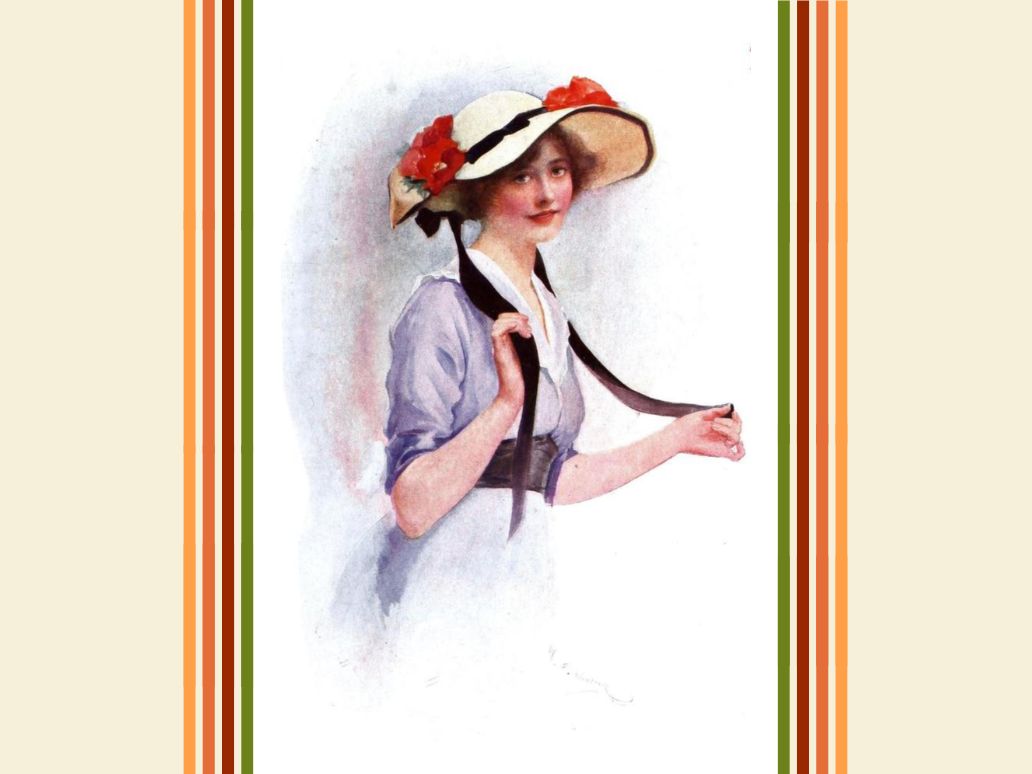
Illustration, by an uncredited artist, appearing on the cover of the April 1915 issue of Maclean’s Magazine. Courtesy of the Internet Archive.
Leave a Reply