
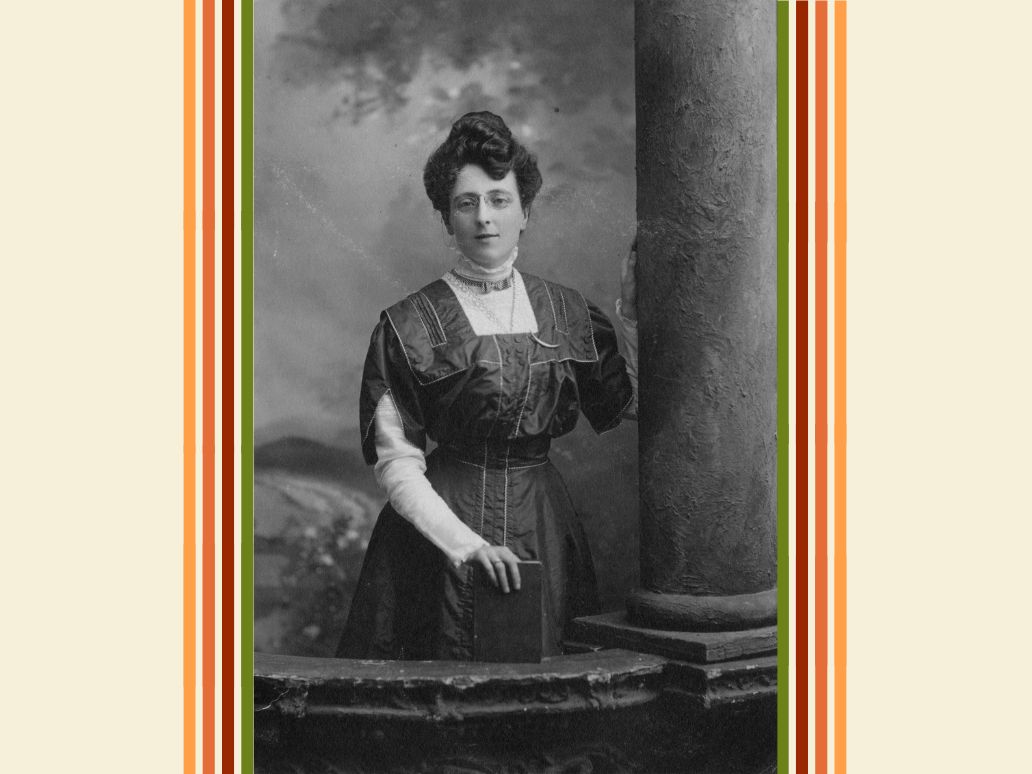
A 1912 profile of L.M. Montgomery in Family Herald and Weekly Star made a number of reductive assumptions about her work.
Contents
Preamble
Men and Women We Read About
Notes
Bibliography
Image Credit
Preamble
A profile of L.M. Montgomery appeared in Montreal’s Family Herald and Weekly Star in December 1912. By this point, six months had elapsed since she’d published her fifth book, Chronicles of Avonlea. Signed “Chesterfield,” the profile appeared (in three long paragraphs) in a column entitled “Men and Women We Read About.”
This profile is of interest for several reasons. First, it repeats several details from Henry James Morgan’s The Canadian Men and Women of the Time, published earlier in 1912, which demonstrates the power that this book had in terms of shaping the information about authors that circulated in the press. That power proved double-edged, since one of the details that Chesterfield’s profile repeats is a birth date that is three years too late.
Second, although Chesterfield praises Montgomery’s work for its high literary quality, the author also makes a claim about her work that subtly undermines her creativity: the idea that she’d drawn her characters “from life.” And yet, in a 1915 essay entitled “The Way to Make a Book,” Montgomery broached that topic in a way that comes across as a response to such claims:
An accusation is often made against us novelists that we paint our characters—especially our ridiculous or unpleasant characters—“from life.” The public seems determined not to allow the smallest particle of creative talent to an author. If you write a book you must have drawn your characters “from life.” You, yourself, are, of course, the hero or heroine; your unfortunate neighbors supply the other portraits. People will cheerfully tell you that they know this or that character of your books intimately. This will aggravate you at first, but later on you will learn to laugh at it. It is, in reality, a subtle compliment—though it is not always meant to be. It is at least a tribute to the “life-likeness” of your book people. (139)
And in an essay entitled “‘I Dwell Among My Own People,’” published around 1921, she made an important comment about what will make fictional characters believable: “Study from life we must, copying suitable heads and arms, appropriating bits of character, personal or mental idiosyncrasies, but the ideal must be behind it all. A writer must create, not copy, her characters or they will never be life-like” (182–83).
Men and Women We Read About
Chesterfield, “Men and Women We Read About,” Family Herald and Weekly Star (Montreal), 25 December 1912, 4.
Among distinguished writers and students the beautiful little province of Prince Edward Island has produced, there have been none whose works have attained the worldwide popularity of books written by Miss Lucy Maud Montgomery, authoress of the “Chronicles of Avonlea,” now appearing in serial in the “Family Herald and Weekly Star.” We obtain some idea of the exceptional hold this gifted writer’s books have had upon the English-speaking world, when we know that her first production, the famous “Anne of Green Gables,” has passed through thirty-three editions; “Anne of Avonlea,” through eighteen; “Kilmeny of the Orchard,” through nine and “The Story Girl” through seven.
This series of beautiful stories, the scenes of which are all laid in the pretty green island [whose] people and those who visit it, love to speak about as “The Garden of the Gulf,” are thrilling yet human—deliciously human, and natural. A near relative, Mr. D. Montgomery, the agent of the Prince Edward Island Railway at Georgetown, once assured me that most of Miss Montgomery’s characters, in fact all the principal ones that we make the acquaintance of and actually seem to live with in her pages, are drawn from life. He added that he knew some of the characters in actual life, and could vouch for the accuracy of the delineation of them by his talented relative.
The delicacy, yet withal vividness, with which all the characters of Miss Montgomery’s books, particularly that of “Anne of Green Gables”—the immortal “Anne” who flits through chapter after chapter, volume after volume, in such a charming and entertaining manner,—is very remarkable and attractive; but not more so than the skill shown in weaving a series of interesting plots which to the last line arrest the attention of the reader.
Miss Montgomery was born at Clifton, P.E.I., in 1877; but from her appearance one would scarcely suspect that she was as old as thirty-five, much less that she had already won fame as an authoress that is given to few to attain. Her father was Mr. Hugh John Montgomery, merchant, who was a son of one of the best known and most influential politicians Prince Edward Island has ever produced, the late Senator Montgomery. This gentleman, who was a man of considerable education and exceptional natural talent as a speaker, and especially remembered as the user of good, plain English, was of mixed Scottish and English extraction. He was the sixth son of Donald Montgomery, Esq., who emigrated from Argyllshire, Scotland, to Prince Edward Island, about the time of the American revolution and who represented Prince County in the old Provincial Assembly of Prince Edward Island for thirty-five years. The Senator, who was born in 1808, sat for Princetown in the Provincial Assembly from 1838 until 1862, and was Speaker of that body for four years. When the Legislative Council of Prince Edward Island was made elective he was returned to that body and became speaker, an office he continued to hold until March, 1874, being for the better part of his term also a Senator, having been called to the Senate of Prince Edward Island, entering the Confederation, October 18th, 1873.
The mother of the authoress was a daughter of the late Alexander McNeil, of Cavendish, and it is probable that she inherited much of her fine literary taste from her, for several members of her mother’s family had a reputation among their neighbors as literary people. Miss Montgomery’s mother dying when she was a mere tot of an infant, she was sent to live with her mother’s parents at Cavendish, P.E.I., where her grandmother acted as a mother to her. She received her earliest education at the Cavendish district school, and did so well there that she readily passed the entrance examinations to Prince of Wales College, Charlottetown, which occupies a place with relation to the ordinary public schools of Prince Edward Island corresponding to that of the Collegiate Institute and High Schools of Quebec and Ontario hold with relation to the public schools of their various cities or districts. After graduating from Prince of Wales College, Miss Montgomery, as many of the graduates of that institution do, taught a district school on the Island for a couple of years, and then went to Halifax and took a course at Dalhousie University. Her father meantime had gone out to Prince Albert, Saskatchewan, and after her course at Dalhousie she spent a winter with him in his Northwestern home.
Miss Montgomery’s natural taste for literature was displayed at a very early age and at the age of nineteen she had her first production accepted by McCall’s Magazine. This at once attracted favorable notice and from that time she became a frequent contributor to a number of popular magazines, her contributions in poetry as well as prose being eagerly sought after. In 1908 he[r] first novel, “Anne of Green Gables,” was published. She wrote the opening chapters and submitted them to a publishing firm for use as magazine matter; but the head of the firm, after reading the proofs, communicated with her, advised her to elaborate the matter and to make a book of it, as it deserved. The result every one knows. “Anne of Avonlea” appeared in 1909, “Kilmeny of the Orchard” in 1910, and “The Story Girl” in 1911.
It is interesting to know that the clean, quaint, rich, old-fashioned humor running through Miss Montgomery’s work strongly appealed to the late Mark Twain, and his opinion[] of “Anne of Green Gables” was expressed in the words: “It is the sweetest creation of child life yet written.” Bliss Carman, the Canadian poet, has put himself on record as believing that “henceforth Anne must always remain one of the immortal children of fiction.” At the end of the year 1909, a vote of the librarians of New York State was taken to provide a list of the fifty best works of fiction produced during the year, and “Anne of Avonlea” not merely appeared on that list, but at the head of it.
By the way, Miss Montgomery in ordinary life is no longer “Miss Montgomery,” for in July, 1911, she became the bride of the Rev. Evan McDonald, a Presbyterian minister, and at present she is the mistress of the Mance [sic] at Leaskdale, Ont.
Notes
“Chronicles of Avonlea,” now appearing in serial in the “Family Herald and Weekly Star.” This serialization, in fourteen instalments, began on 27 November 1912 and concluded on 26 February 1913.
A near relative, Mr. D. Montgomery. Donald Montgomery (1836–1919), a cousin of Montgomery’s father (LMMCJ, 5: 24n34). Quoting these sentences in a journal entry dated 1 March 1930, Montgomery came across as more amused than annoyed. “Poor Cousin Dan! I’m afraid his desire for the limelight betrayed him that time. I don’t suppose he ever thought I’d see it” (Montgomery, 1 March 1930, in LMMCJ, 5: 24–25).
“The Garden of the Gulf.” Popular term for Prince Edward Island, as seen in a book of photographs published in 1903 entitled Prince Edward Island: The Garden of the Gulf.
born . . . in 1877. This erroneous birthdate, which made Montgomery three years younger than she was, also appeared in the entry on Montgomery in Henry James Morgan’s The Canadian Men and Women of the Time, published the same year as this essay.
she spent a winter with him in his Northwestern home. Montgomery went to live with her father and her new stepmother in Prince Albert (in what is now Saskatchewan) in 1890, when she was fifteen, thus before she attended Prince of Wales College or became a schoolteacher. She returned to Prince Edward Island after a year.
she had her first production accepted by McCall’s Magazine. McCall’s Magazine began publishing under that title in 1897. So far, there is no indication that Montgomery ever published her work in that periodical.
“It is the sweetest creation of child life yet written.” This misquotation from Twain also appears in the entry on Montgomery in Henry James Morgan’s The Canadian Men and Women of the Time.
“henceforth Anne must always remain one of the immortal children of fiction.” This excerpt from a letter by Bliss Carman circulated in several newspapers within a year of the publication of Anne of Green Gables. For one example, see “[Such a Delightful Little Person]” in volume 1 of The L.M. Montgomery Reader.
the librarians of New York State. This tidbit likewise appears in the entry on Montgomery in Henry James Morgan’s The Canadian Men and Women of the Time.
She wrote the opening chapters and submitted them to a publishing firm. Perhaps the author of this profile misunderstood the origins of the novel that Montgomery had started circulating almost immediately after the publication of Anne of Green Gables: that she started writing the novel as a serial in response to a request from the editor of a Sunday school magazine but that, soon in the process of developing the concept, her imagination took over until she had enough brainstorming done for a novel-length manuscript. One version of this account, published as “Author Tells How He Wrote His Story,” appears in volume 1 of The L.M. Montgomery Reader. In the afterword to Schooled with Briars, I put forth Montgomery’s fiction serial “The Running Away of Chester” as a possibility for the serial that Montgomery wrote instead.
Bibliography
“Author Tells How He Wrote His Story.” In Lefebvre, The L.M. Montgomery Reader, 1: 3–28. https://doi.org/10.3138/9781442668560-006.
Lefebvre, Benjamin. Afterword to Schooled with Briars: Collected Serials, 1903–1913, by L.M. Montgomery, edited by Benjamin Lefebvre, 301–62. University of Toronto Press, 2025. The L.M. Montgomery Library. https://doi.org/10.3138/9781487518134-012.
—. “Introduction: A Life in Print.” In Lefebvre, The L.M. Montgomery Reader, 1: 3–28. https://doi.org/10.3138/9781442668560-003.
—, ed. The L.M. Montgomery Reader, Volume 1: A Life in Print. University of Toronto Press, 2013. https://doi.org/10.3138/9781442668560.
“McCall’s.” The Online Books Page, n.d. https://onlinebooks.library.upenn.edu/webbin/serial?id=mccalls.
Montgomery, L.M. Chronicles of Avonlea. L.C. Page and Company, 1912.
—. “‘I Dwell Among My Own People.’” In Lefebvre, The L.M. Montgomery Reader, 1: 182–83. https://doi.org/10.3138/9781442668560-039.
—. L.M. Montgomery’s Complete Journals: The Ontario Years, 1930–1933. Edited by Jen Rubio. Rock’s Mills Press, 2019.
—. “The Way to Make a Book.” In Lefebvre, The L.M. Montgomery Reader, 1: 137–43. https://doi.org/10.3138/9781442668560-028.
Prince Edward Island: The Garden of the Gulf. Carter and Company; James Bayne Company, [1903]. https://archive.org/details/princeedwardisla0000unse_d3u6/.
“[Such a Delightful Little Person].” In Lefebvre, The L.M. Montgomery Reader, 1: https://doi.org/10.3138/9781442668560-005.
Image Credit
Photograph of L.M. Montgomery, similar to the photograph that accompanies this article in Family Herald and Weekly Star above the caption “Miss L.M. Montgomery.” Courtesy of the L.M. Montgomery Collection, Archival and Special Collections, University of Guelph Library.
Leave a Reply