
In October 1909, the Toronto Globe published a profile of L.M. Montgomery by Donald G. French that told of Montgomery’s start as a writer.
Contents
Preamble
“Miss Montgomery, Canadian Author”
Abbreviations
Notes
Bibliography
Image Credit
Preamble
This profile of L.M. Montgomery appeared in the Toronto Globe a month after the publication of her second novel, Anne of Avonlea, in 1909. It has many elements in common with several early profiles of her, all of which appear to draw, in different ways, on a short autobiographical sketch (now lost) that Montgomery sent to her publisher as part of the marketing campaign for her first book, Anne of Green Gables (1908).
This letter—or letters plural—is significant in terms of what they include and what they leave out. The version here provides a detailed overview of her education and her teaching career, but it omits the year Montgomery spent in Prince Albert (in what is now Saskatchewan) when she was an adolescent. Moreover, by implying that the acceptance of a poem to an American magazine was her first publication, she overlooked several more publications in the form of prose, poetry, or non-fiction that had preceded this one, perhaps because most of these had not involved payment.
Comparing these early profiles reveals how and when reporters used Montgomery’s first-person account as a starting point. Her sentence about “writing stories and verse for my own amusement” appears in two more published accounts from 1908 (see “Author Tells How He Wrote His Story,” 33; “Origin of Popular Book,” 35). But the phrase beginning with “my first plunge into the sea of journalism” is absent from those versions. Notably, an unsigned piece first published in Zion’s Herald one month before French’s article includes similar phrasing: “As far back as she can remember she wrote stories and verse for her own amusement. Her first plunge into the sea of journalism was taken when she was at Prince of Wales, when she wrote a poem, ‘To a Violet,” and it was accepted by an American household magazine” (“The Author of Anne of Avonlea,” 38). French’s article, while it appears to quote Montgomery verbatim, omits the title of the poem.
These profiles also include the starting point for a habit Montgomery had in public statements to downplay her own creativity by claiming that she’d drawn many of the elements in fiction “from life.” Her frequent reference to Topsy, a character in Harriet Beecher Stowe’s Uncle Tom’s Cabin, stands in pointed contrast with how she described her process of writing Anne of Green Gables to her correspondent Ephraim Weber: “I revised and re-wrote and altered words until I nearly bewildered myself” (Montgomery to Weber, 10 September 1908, in GGL, 73).
And as I pointed out in my most recent book, The Glory and the Dream: L.M. Montgomery’s Writing Life, Montgomery acknowledged in a journal entry dated 27 January 1911 that “Cavendish is to a large extent Avonlea,” but she went on to detail all the instances in which she’d modified reality to suit her fictional world. French’s profile, like so many others, repeats the general statement and not the exceptions when he refers to Cavendish as “the ‘Avonlea’ of her stories.” Perhaps that’s why, when she drew on that 1911 journal entry for her 1917 celebrity memoir “The Alpine Path: The Story of My Career,” she made a minor but significant change to her phrasing: “Cavendish was ‘Avonlea’ to a certain extent” (Montgomery, 27 January 1911, in CJLMM, 2: 348; NH, 290; Lefebvre, The Glory and the Dream, 151).
This would be the first of many times that Donald G. French would write about Montgomery and her work. His most detailed commentary appeared in Highways of Canadian Literature: A Synoptic Introduction to the Literary History of Canada (English) from 1760 to 1924, which he wrote jointly with J.D. Logan and which was published in 1924, with a second edition appearing in 1928. But as I mention both in an earlier article on this website and in my most recent book, French had a tendency to repeat himself in his newspaper and magazine comments about Montgomery’s work (see Lefebvre, “L.M. Montgomery, Jane Austen, and Self-Repetition”; Lefebvre, The Glory and the Dream, 172–74).
“Miss Montgomery, Canadian Author”
D.G. French, “Miss Montgomery, Canadian Author,” Globe (Toronto), 9 October 1909, Saturday Magazine section, 5.
Miss L.M. Montgomery, the successful author of “Anne of Green Gables” and “Anne of Avonlea,” was born in Clifton, Prince Edward Island, where her father, Hugh John Montgomery, son of Senator Montgomery, was a merchant. Her mother died when Miss Montgomery was very young, and she was brought up by her maternal grandparents in Cavendish, P.E.I., a seashore farming settlement, the “Avonlea” of her stories. She attended the district school near her home, then spent one year at Prince of Wales College, Charlottetown, another at teaching, then one at Dalhousie College, Halifax. Two years more were occupied with school teaching, then the death of her grandfather made it necessary for her to live with her grandmother in Cavendish.
Of the beginning of her literary career Miss Montgomery says: “As far back as my memory runs, I was writing stories and verse for my own amusement; but my first plunge into the sea of journalism was made when I was at the Prince of Wales College, when I wrote a poem which was accepted by an American magazine.”
Until about three years ago Miss Montgomery’s work was chiefly verse and short stories for magazines. The creation of “Anne” was in a sense an accident. The author explains that on one occasion she was asked for a short serial for a Sunday school paper, and, looking through her notebook, found a suggestive theme in the note: “Elderly couple apply to orphan asylum for a boy; a girl is sent to them.” She did not have time to prepare the short serial when it was needed, but she brooded over the theme, and “Anne” soon grew far beyond the limitations of a few short chapters of a Sunday school serial. From this incident the author evolved “Anne of Green Gables,” which has since delighted thousands of readers. Miss Montgomery says of the book: “It is really a mistake to say that I ‘created’ Anne; like Topsy, she ‘growed’ of her own accord, and I simply seemed to watch and describe her growth. The characters are wholly imaginary, but many of the places and some of the incidents were drawn from life.”
In “Anne of Avonlea” Miss Montgomery has added to the great success of her first long story, and future works from her pen will be eagerly looked for.
Abbreviations
CJLMM, 2: The Complete Journals of L.M. Montgomery: The PEI Years, 1901–1911
GGL: The Green Gables Letters from L.M. Montgomery to Ephraim Weber, 1905–1909
NH: A Name for Herself: Selected Writings, 1891–1917
SJLMM: The Selected Journals of L.M. Montgomery
Notes
her father. Hugh John Montgomery (1841–1900) moved to Prince Albert, Saskatchewan, where he started a second family. Montgomery spent a year with him there as a teenager (a span of time omitted in this profile), and after she returned to Prince Edward Island in 1891, they continued to correspond but never saw each other again.
Senator Montgomery. Senator Donald Montgomery, paternal grandfather of L.M. Montgomery, had represented PEI in Ottawa from 1874 until his death in 1893 (Rubio and Waterston, introduction to SJLMM, 1: xiii).
Her mother. Clara (née Macneill) Montgomery (1853–1876) died of tuberculosis when Montgomery was twenty-two months old.
her grandfather . . . her grandmother. Alexander Macneill, Montgomery’s maternal grandfather, died suddenly in March 1898. Montgomery returned home to Cavendish at that point, and with the exception of a nine-month stint in Halifax, during which she worked on the staff of the Halifax Daily Echo, she lived with her grandmother, Lucy Woolner Macneill, until her grandmother’s death in 1911.
like Topsy, she ‘growed.’ In her Broadview critical edition of Anne of Green Gables, Cecily Devereux identifies “Topsy” as an allusion to Harriet Beecher Stowe’s 1852 novel Uncle Tom’s Cabin, in which Topsy, an enslaved African American girl, claims she had no parents, but rather, “I ’spects I growed” (Devereux, in Montgomery, Anne of Green Gables, edited by Devereux, 365n1). This allusion appeared in several more early profiles of Montgomery as well as in her 1915 essay “The Way to Make a Book” and her contributions to Fiction Writers on Fiction Writing (1923). See “Origin of Popular Book,” 36; “The Author of Anne of Avonlea,” 39; Sinclair, “A Trio of Women Writers,” 46; “L.M. Montgomery at Women’s Canadian Club,” 127; Montgomery, “The Way to Make a Book,” 138; “From Fiction Writers on Fiction Writing,” 189–90;
Bibliography
“Author Tells How He Wrote His Story.” In Lefebvre, The L.M. Montgomery Reader, 1: 33–34. https://doi.org/10.3138/9781442668560-006.
“The Author of Anne of Avonlea.” In Lefebvre, The L.M. Montgomery Reader, 1: 37–39. https://doi.org/10.3138/9781442668560-008.
“From Fiction Writers on Fiction Writing: Advice, Opinions and a Statement of Their Own Working Methods by More Than One Hundred Authors.” In Lefebvre, The L.M. Montgomery Reader, 1: 189–96. https://doi.org/10.3138/9781442668560-041.
Lefebvre, Benjamin. The Glory and the Dream: L.M. Montgomery’s Writing Life. Dundurn Press, 2026.
—. “L.M. Montgomery, Jane Austen, and Self-Repetition.” L.M. Montgomery Online, 26 September 2020. https://lmmonline.org/texts-and-contexts/lm-montgomery-jane-austen-and-self-repetition/.
—, ed. The L.M. Montgomery Reader, Volume 1: A Life in Print. University of Toronto Press, 2013. https://doi.org/10.3138/9781442668560.
“L.M. Montgomery at Women’s Canadian Club.” In Lefebvre, The L.M. Montgomery Reader, 1: 126–28. https://doi.org/10.3138/9781442668560-025.
Montgomery, L.M. Anne of Avonlea. L.C. Page and Company, 1909.
—. Anne of Green Gables. L.C. Page and Company, 1908.
—. Anne of Green Gables. Edited by Cecily Devereux. Broadview Press, 2004. Broadview Editions.
—. “The Way to Make a Book.” In Lefebvre, The L.M. Montgomery Reader, 1: 137–43. https://doi.org/10.3138/9781442668560-028.
“Origin of Popular Book.” In Lefebvre, The L.M. Montgomery Reader, 1: 35–36.
Rubio, Mary, and Elizabeth Waterston. Introduction to The Selected Journals of L.M. Montgomery, Volume 1: 1889–1910, edited by Mary Rubio and Elizabeth Waterston, xiii–xxiv. Oxford University Press, 1985.
Sinclair, Donald B. “A Trio of Women Writers.” In Lefebvre, The L.M. Montgomery Reader, 1: 44–47.
Image Credit
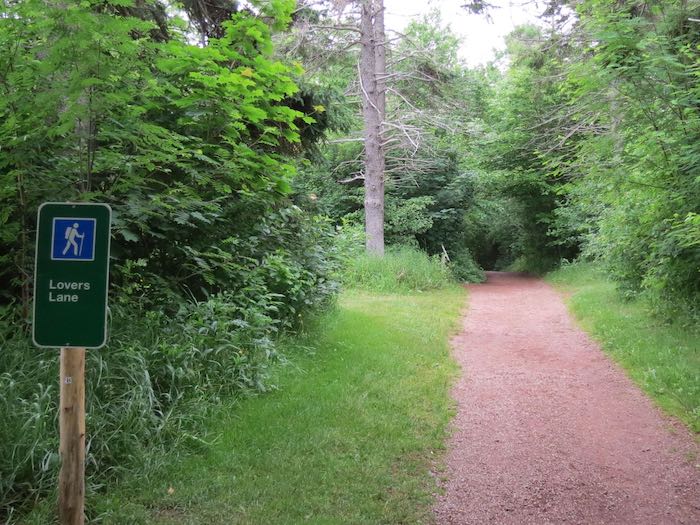
Photograph, taken presumably by L.M. Montgomery, of Lover’s Lane in Cavendish, PEI. It appears in French’s article, accompanied by the caption “‘Lover’s Lane,’ of Miss Montgomery’s stories.” Courtesy of the L.M. Montgomery Collection, Archival and Special Collections, University of Guelph library.
Leave a Reply