
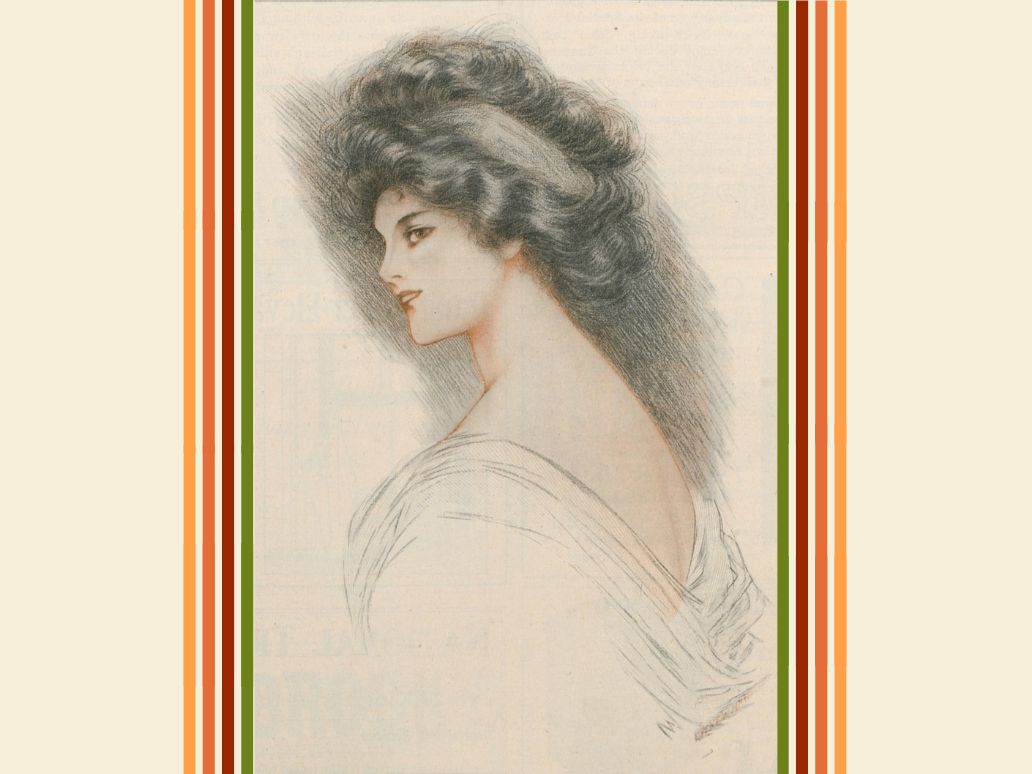
In 1910, Marjory MacMurchy wrote a profile of Montgomery entitled “Prince Edward Island’s Novelist” that appeared in The Canadian Courier.
Contents
Preamble
Prince Edward Island’s Novelist
Notes
Bibliography
Image Credit
Preamble
The Canadian Courier, a Toronto magazine, published a profile of L.M. Montgomery in its 18 June 1910 issue. By this point, L.C. Page of Boston had published Montgomery’s first three novels: Anne of Green Gables in June 1908, Anne of Avonlea in September 1909, and Kilmeny of the Orchard in March 1910. Marjory MacMurchy (1870–1938), who wrote the profile, comes across as enthusiastic about Montgomery’s work, but with reservations.
Volume 1 of The L.M. Montgomery Reader includes two of MacMurchy’s later profiles of Montgomery that originally appeared in several newspapers across Canada.
Prince Edward Island’s Novelist
Marjory MacMurchy, “Prince Edward Island’s Novelist,” The Canadian Courier (Toronto), 18 June 1910, 27. https://www.canadiana.ca/view/oocihm.8_06911_186/27.
No other province in the Dominion has been so attractively, delicately painted as Prince Edward Island has been by Miss Montgomery. Her three stories, “Anne of Green Gables,” “Anne of Avonlea,” and “Kilmeny of the Orchard,” are transcripts of the out-of-doors of one of the loveliest islands in the world. Homesteads and country schools, woods and orchards, wild rose hedges and the song of the salt air from the gulf, long red roads and field-stone dykes, stand in her stories exactly as they do in everyday life, homes and wayfarings of the island people, who are as hardy and individual, as adventurous, well-doing and intellectually able, as the best friend of the Canadian type could wish for its permanent development. The island temperament has bonhomie, and enjoyment of life is interpreted with unfailing gayety in Miss Montgomery’s island stories.
“Kilmeny of the Orchard,” which is published, as was the case with Miss Montgomery’s former books, by L.C. Page and Company of Boston, will charm its readers with the shining light and shade and loveliness of the Island landscape. Eric Marshall, a young Nova Scotian college graduate, who is to enter into a business partnership with his father, and for a friend’s sake first teaches for some months in an Island school, closes the schoolhouse door behind him and looks on such a scene as this.
“The sun was slanting in warm yellow lines through the thick grove of maples to the west of the building, and the dim green air beneath them burst into golden bloom. A couple of sheep were nibbling the lush grass in a far corner of the play-ground; a cow-bell, somewhere in the maple woods, tinkled faintly and musically on the still crystal air, which in spite of its blandness still retained a touch of the wholesome austerity and poignancy of a Canadian spring. The whole world seemed to have fallen, for the time being, into a pleasant untroubled dream.”
Later, when the schoolmaster meets Kilmeny in the orchard, the poet in the Island novelist will not be denied an ecstatic praise of light and earth and sky. “They lingered in the orchard until the long, slow-moving shadows of the trees crept to their feet. It was just after sunset, and the distant hills were perfect against the melting saffron of the sky in the west and the crystalline blue of the sky in the south. Eastward, over the fir woods, were clouds, white and high heaped like snow mountains, and the westernmost of them shone with a glow as of sunset on an Alpine height.
“The higher worlds of air were still full of light—perfect, stainless light, unmarred of earth shadow; but down in the orchard and under the spruces the light had almost gone, giving place to a green, dewy dusk, made passionately sweet with the breath of the apple blossoms and mint and the balsamic odours that rained down upon them from the firs.”
The story of Kilmeny brings the schoolmaster to find her in the orchard by the strains of her violin, which is her only voice, for Kilmeny is dumb. If Anne, little friend of all the world, was genial and happy and generous, an imaginative child who trusted everyone, Kilmeny is a remote maiden, a romantic heroine. Kilmeny is under a spell. Kilmeny’s mother had married a man who believed himself to be free, but whose first wife proved to be living after his second marriage. Kilmeny’s mother became utterly bitter. Her father was cruel to her. She never forgave him, refusing to speak to him even when he was dying. When her child was born dumb, she believed it to be a punishment, and kept Kilmeny in entire seclusion, which was not broken even after her mother’s death. She is an utterly innocent, beautiful child when Marshall finds her in the orchard. Although she cannot speak she can hear, and when the schoolmaster talks to her she answers him by writing on a slate. Miss Montgomery, on the whole, has handled this uncommon and difficult situation skilfully. But it must be confessed that Kilmeny’s conversations are too long and too eloquent to have been written on a slate. But in such a situation what can a novelist do? The romantic pathos of Kilmeny’s inherited punishment and her beauty stay with the reader like a strain of lovely music after the book has been closed. It is a happy ending, for she finds speech at last through love.
It would be easy to praise Miss Montgomery’s books to highly. They are delightfully fresh and simple, with the charm of what is naturally attractive and wholesome, and they are enriched by the play of a poetical fancy.
“Kilmeny of the Orchard” does not show any decided advance on “Anne of Green Gables.” It lacks Anne’s genial spirit and her spontaneous humour. On the other hand “Kilmeny” does not owe to any other book what “Anne of Green Gables” owed to Mrs. Riggs’ “Rebecca of Sunnybrook Farm.” It is not likely that Miss Montgomery has shown all her powers yet. Her stories do not reveal genius, but they are the work of a charming talent. The spirit of goodness in them and the deep spirit of a strong national life ring as clearly as evening bells. If any reader doubts this, let him listen to little Anne when one of her friends wishes for wealth and diamonds.
“We are rich,” said Anne stanchly. “Why we have sixteen years to our credit, and we’re happy as queens, and we’ve all got imagination, more or less. Look at that sea, girls—all silver and shadow and vision of things not seen. We couldn’t enjoy its loveliness any more if we had millions of dollars and ropes of diamonds. You wouldn’t change into any of these women if you could. Would you want to be that white lace girl and wear a sour look all your life, as if you’d been born turning up your nose at the world? Or the pink lady kind and nice as she is, so stout and short that you’d really no figure at all? Or, even Mrs. Evans, with that sad, sad look in her eyes? She must have been dreadfully unhappy sometime to have such a look. You know you wouldn’t, Jane Andrews!”
“I don’t know—exactly,” said Jane unconvinced. “I think diamonds would comfort a person for a good deal.”
“Well, I don’t want to be anyone but myself, even if I go uncomforted by diamonds all my life,” declared Anne. “I’m quite content to be Anne of Green Gables, with my string of pearl beads. I know Matthew gave me as much love with them as ever went with Madame the Pink Lady’s jewels.”
Notes
bonhomie. “Cheerful friendliness or good nature; geniality, affability” (Oxford English Dictionary, “bonhomie, n.”).
“The sun was slanting . . . a pleasant untroubled dream.” This excerpt appears (with a few minor differences in terms of punctuation) in chapter 3 of Kilmeny of the Orchard (see KO, 31–32).
“They lingered in the orchard . . . rained down upon them from the firs.” This excerpt appears in chapter 7 of Kilmeny of the Orchard (see KO, 98–99), which details Kilmeny and Eric’s first meeting. The excerpt contains a few transcription errors: “long, slow-moving shadows” should be “long, languid shadows”; “the distant hills were perfect” should be “the distant hills were purple”; “Eastward, over the fir woods” should be “Eastward, just over the first woods”; “shone with a glow” should be “shone with a rosy glow” (KO, 98).
Mrs. Riggs’ “Rebecca of Sunnybrook Farm.” Kate Douglas Wiggin, author of the 1903 novel Rebecca of Sunnybrook Farm, had married George C. Riggs in 1895 (see “Kate Douglas Wiggin”).
“We are rich . . . Madame the Pink Lady’s jewels.” This conversation between Anne, Diana, and Jane appears at the end of chapter 33 of Anne of Green Gables (see AGG, 381–82), except that a few italicized terms in the novel are unitalicized.
Bibliography
“Kate Douglas Wiggin.” Encyclopedia Britannica, 24 September 2025. https://www.britannica.com/biography/Kate-Douglas-Wiggin.
Lefebvre, Benjamin, ed. The L.M. Montgomery Reader , Volume 1: A Life in Print. University of Toronto Press, 2013.
MacMurchy, Marjory. “L.M. Montgomery of the Island.” In Lefebvre, The L.M. Montgomery Reader, 1: 129–33. https://doi.org/10.3138/9781442668560-026.
—. “L.M. Montgomery: Story Writer.” In Lefebvre, The L.M. Montgomery Reader, 1: 120–25. https://doi.org/10.3138/9781442668560-024.
Montgomery, L.M. Anne of Avonlea. L.C. Page and Company, 1909.
—. Anne of Green Gables. L.C. Page and Company, 1908.
—. Kilmeny of the Orchard. L.C. Page and Company, 1910.
Image Credit
Detail from the cover (featuring unattributed artwork) of the 18 June 1910 issue of The Canadian Courier, a Toronto-based magazine. Courtesy of Canadiana.ca/Canadian Research Knowledge Network.
Leave a Reply